

The client
JAX is a historic American manufacturer with over 70 years of history, firmly established as an undisputed benchmark in high-performance industrial lubricants. Its leadership is especially notable in food-grade solutions and technology (NSF H1/3H certifications), making it a key partner for highly regulated, demanding industries such as Food & Beverage, pharmaceuticals and manufacturing.
It is a brand with an inherently technical, straightforward DNA whose differentiating value revolves around efficiency. Its entire value proposition focuses on ensuring peak machinery performance and flawless operational safety for its clients.
The challenge
The project had a clear, ambitious business objective: boost brand awareness and scale qualified demand generation in the United States, its primary market, focused on its industrial and food-grade lubricant lines.
The scenario carried obstacles inherent to a high-complexity B2B ecosystem. The industry demands navigating very long sales cycles and high-value purchase tickets. And conversion does not depend on a single stakeholder: it requires reaching and convincing multiple decision-makers with differing priorities, from technical maintenance staff to operations directors and procurement managers.
On digital assets, JAX held a latent competitive advantage: a robust website with an extensive portfolio of dozens of product pages. That was an unbeatable opportunity to capture transactional search intent through solid SEO.
Discover how we can help you by activating our SEO levers.
However, to capitalise on this traffic and scale paid campaigns without losing efficiency, a critical analytics challenge stood in the way. The data ecosystem was fragmented and needed unifying. The technical challenge: integrating GA4, Google Search Console and Google Ads into a single environment. Full traceability across such a long funnel was the prerequisite for investing profitably, allocating budget to the right channel and not undervaluing high-value leads that take months to close.
How we did it
We designed an omnichannel approach where the mix of channels covered the entire conversion funnel:
- Paid Media (awareness and acquisition): to widen the top of the funnel (prospecting) we launched Display campaigns segmented by industrial vertical (Dairy, Bakery, Can Manufacturing, Beverage, Pet Food) plus PMax. For direct acquisition, we captured existing demand with SEM based on search intent (terms like industrial lubricants, food grade lubricants, dielectric grease), using exact match and negatives to protect efficiency.
- SEO, CRO and Content: we prioritised the URLs with the highest commercial potential and optimised on-page SEO. We built intent-match landing pages focused on product and industry, with micro-conversions (click-to-call, click-to-email, downloads) to capture high-intent traffic. We also reinforced the Knowledge Hub with technical content for engineers to support the sales conversation.
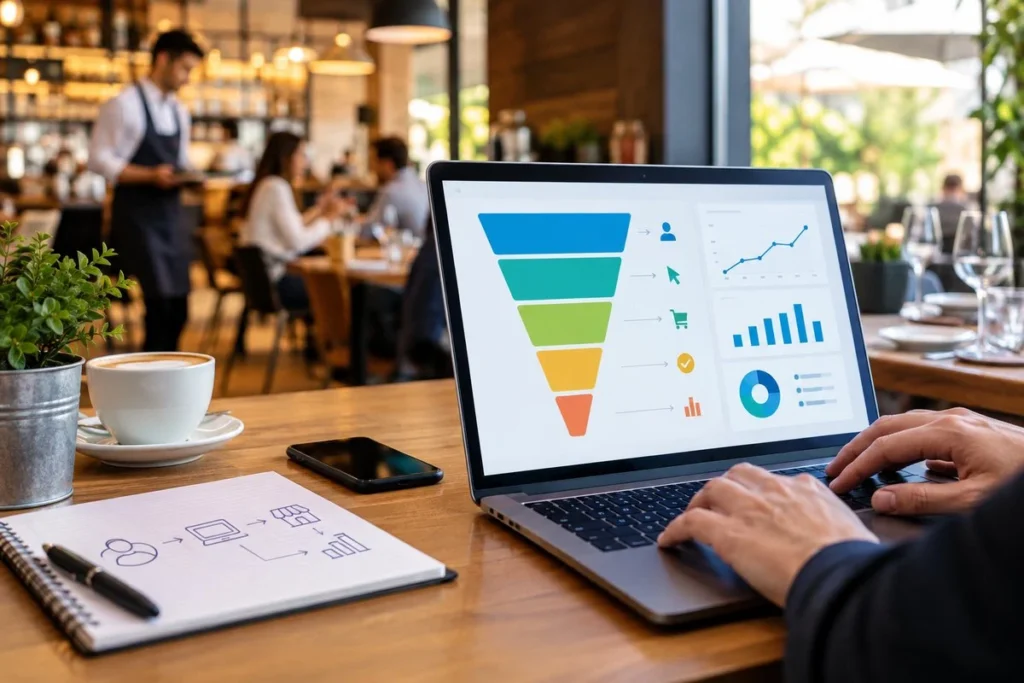
- Unified analytics: we consolidated every source into a single dashboard for a clear executive read (sessions, impressions, CTR, CPL and leads by type). This signal-level measurement was key to not undervaluing high-value leads.
Results
The omnichannel ecosystem worked in perfect synergy: the organic channel and SEM captured existing demand at the bottom of the funnel, while Display and PMax prospecting broadened brand visibility across industries. It exceeded growth expectations and proved you can scale acquisition while staying profitable in a complex industrial B2B.
Since 2023, over 3 years of collaboration:
- Lead volume: 4,623 total leads attributed to digital channels (1,571 via phone, 931 via email and the rest through forms).
- Ad efficiency (Google Ads): 1.48 million impressions and 51,644 clicks at a 3.49% CTR. Cost per conversion held at an average of $36.80 (CPL around €33). The Display lines segmented by industrial vertical stood out, with very low CPLs between $14 and $18.
- Organic visibility explosion: SEO and content delivered 572,000 sessions (with a 36.87% engagement rate) and 8 million impressions on Google, translating into more than 60,300 organic clicks in Search Console.
"The campaign and content mix allowed us to increase visibility in the US and, above all, capture qualified leads at sustainable costs within a complex B2B environment."