

The client
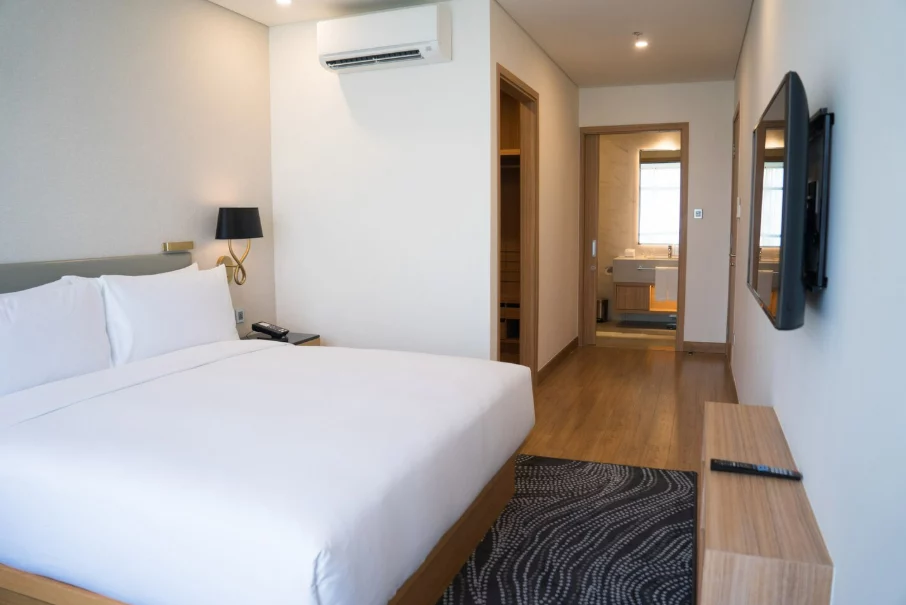
The client is a Spanish hotel chain consisting of four hotels. Before working with cronuts.digital, its digital presence relied almost exclusively on brand traffic, without a well-established strategy for technical SEO or local SEO, without visibility on artificial intelligence (GEO) search engines, and without any reliable system for measuring results.
The challenge
The project began with an overall digital assessment score of just 44 out of 100, with AI visibility at a concerning 10 out of 100. Before touching a single page, we audited the hotel’s entire digital ecosystem, not one stray URL. The breakdown made the priority clear:
AI visibility was the lowest point and, at the same time, the biggest opportunity: no competitor in the area had worked on it. Behind those numbers lay four specific problems:
- Almost exclusively brand traffic: for generic searches such as “hotels in [city],” despite a good ranking and thousands of impressions, the CTR was 1.2% (the healthy range is between 8% and 15%).
- Zero measurement: Google Analytics was showing 0 conversions because no one had set up the events or connected the external booking engine.
- No structured data: none of the pages had schema markup, so neither Google nor AI understood that it was a hotel.
- Failing mobile performance: the mobile LCP was 3.3 seconds, well above the recommended threshold of 2.5 seconds.
How we did it
What an SEO and GEO audit for hotels reviews
An SEO and GEO audit for hotels reviews four connected layers. Each one drags the others along; it’s not about running a tool and exporting a PDF.
Technical SEO. It started with 43 pages lacking meta titles and descriptions, confirmation pages indexed by mistake, an unoptimized sitemap and an old-to-new domain transition that needed watching.
GEO and AI visibility. GEO optimizes so engines like ChatGPT, Perplexity, Google AI Overviews or Microsoft Copilot find and cite the business. The site started from zero: no structured data, no llms.txt file and invisible in the Bing index that Copilot and DuckDuckGo draw from.
Local SEO and Google Business Profile. Auditing the four hotels’ listings revealed descriptions without local keywords, incomplete services and no strategy for posts or review replies. Starting score: 45 out of 100.
Analytics configuration. The biggest gap: the property received sessions but recorded 0 conversions and 0 useful views, and the booking engine, hosted on an external domain, wasn’t connected. The business was operating blind.
How we improved each area
We implemented the digital transformation strategy in phases, prioritizing the greatest opportunity we identified: visibility in AI, an area that no competitor in the region had yet explored.
Technical SEO
- Rewrite 43 meta titles and descriptions based on CTR criteria, not just filler content.
- Indexing correction (noindex on confirmation pages).
- Implemented full-page caching, bringing mobile performance to 95/100 on Lighthouse.
- Cleaning up the backlink profile using a disavow file for spam domains.
GEO and Visibility in AI
- Implementation of the LodgingBusiness schema in the profiles for the four hotels (rooms, reviews, coordinates, and FAQPage).
- Publish the llms.txt file to the site’s root directory.
- Registering the site with Bing Webmaster Tools, key to appearing in Copilot and DuckDuckGo.
Local SEO
- Rewriting the descriptions on Google Business Profile listings using local keywords.
- Completing attributes and services.
- A schedule for regular posts and templates for responding to reviews within 24–48 hours.
Optimizing Analytics
- Correction to the Google Analytics base settings.
- Creating conversion events (click to book, click to call, form submission).
- Connecting the external booking engine via cross-domain tracking, measuring the entire booking funnel: search, hotel selection, room selection, checkout, and purchase with revenue.
- Configuring cookie consent (Consent Mode v2) in compliance with the GDPR.
Results
The results were measured about three weeks after applying the audit. Sources: Google Analytics, Search Console, Semrush, SE Ranking and Lighthouse.
The biggest jump came in the generic keywords, where the money was being given away: from position 40 to 8, from 34 to 10 and from 46 to 4.
In just three weeks, funnel optimization and the SEO/GEO strategy completely transformed the client’s digital operations: 77% of the 132 monitored keywords improved their rankings, organic traffic grew by 28% in clicks and impressions, and the average ranking dropped from 5.4 to 4.9. The website, which previously didn’t track a single conversion, now has a fully functional booking funnel generating actual revenue. Furthermore, with the LodgingBusiness schema and the llms.txt file already implemented, the chain is positioned as a pioneer in AI-powered search engine visibility compared to its direct competitors, laying the foundation for sustained long-term growth.
Frequently asked questions
What is an SEO and GEO audit for hotels?
It’s the complete analysis of a hotel’s website across traditional search engines and AI answer engines. It reviews technical SEO, content, local SEO, the Google listing and analytics to detect what traffic and bookings are being lost.
What’s the difference between SEO and GEO?
SEO optimizes ranking in search engines like Google. GEO optimizes so AI answer engines (ChatGPT, Perplexity, AI Overviews, Copilot) find and cite the business. They share a technical base, but GEO prioritizes extractable content, structured data and llms.txt.
How long does it take to see results from a hotel SEO audit?
Results start showing within weeks in ranking and technical visibility. In this case, 77% of the keywords rose in three weeks. Clicks (CTR) lag 30 to 45 days behind, and AI visibility takes a bit longer.
Why doesn’t my hotel show up in ChatGPT or Google AI Overviews?
Because it lacks a GEO foundation: no structured data (schema), no llms.txt file, no extractable content and no Bing indexing. Without those signals, AI engines have nothing to cite.
What is the LodgingBusiness schema for in a hotel?
It’s the structured data that tells Google and AI that the site is a hotel, with rooms, ratings, services and location. It enables rich results and helps generative engines understand and cite the property.
How do you measure a booking if the engine is on another domain?
By connecting that domain to Google Analytics via cross-domain tracking and a dedicated tag container. This records the full funnel: search, room selection, checkout and purchase with revenue, even if the booking happens outside the main site.
What is CTR and why does it matter for a hotel?
CTR is the percentage of people who see the result on Google and click. It matters because a hotel can rank well and still get few clicks if the title and description aren’t compelling. A 1.2% CTR on generic terms is traffic handed to the competition.