
![Meta Ads B2B: How to Target Decision-Makers on Instagram [AWS Case Study]](https://cronuts.digital/wp-content/uploads/2026/07/portada-71006-1-1024x538.webp)
TL;DR · executive summary
What you’ll find in this article
Amazon Web Services uses Instagram and Facebook to capture qualified B2B leads—with job title, company and direct phone number—at a cost per lead between 3 and 5 times lower than on LinkedIn. In this article we dissect the exact funnel, compare real metrics from both channels and explain how to replicate it in any B2B company with a reasonable budget....
Amazon Web Services uses Instagram and Facebook to capture qualified B2B leads—with job title, company and direct phone number—at a cost per lead between 3 and 5 times lower than on LinkedIn. In this article we dissect the exact funnel, compare real metrics from both channels and explain how to replicate it in any B2B company with a reasonable budget.
90% of B2B companies ignore Instagram because “their clients are not there.” This is a misdiagnosis.
What you will learn in this article
- How AWS turns an Instagram user into a qualified prospect with 5 fields
- Why CPL on Meta can be up to 5 times cheaper than on LinkedIn
- How much time your clients spend on Instagram vs LinkedIn every day
- Why in B2B you need to nurture the need before selling
- How to replicate this model in your company with a reasonable budget
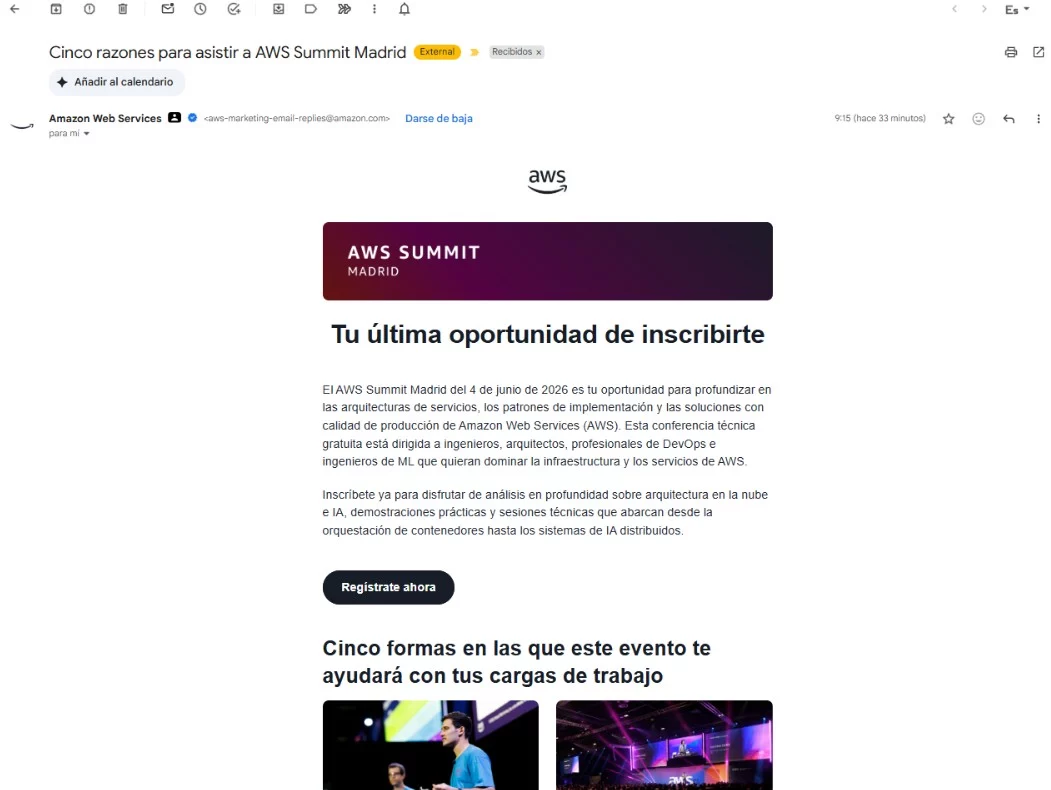
The AWS funnel, broken down step by step
Amazon Web Services is not on Instagram by accident. It has designed a B2B lead generation funnel that turns a relaxed user into a prospect with name, job title, company and direct phone number. These are the four steps:
Step 1 — Attention in receptive mode
The ad appears on Instagram while the operations director is scrolling on the sofa. Not in work mode. In receptive mode. The video featuring real case studies with NVIDIA on AI and infrastructure triggers recognition of a latent problem: “this could be relevant to me.” It does not interrupt. It hooks.
Step 2 — Value exchange
The landing page offers an IDC InfoBrief — third-party content with research credibility, not a sales PDF. The user perceives real value before giving anything. That is the implicit contract that opens the conversation. If the lead magnet does not have genuine perceived value, the form will not convert.
Step 3 — The qualifying form (this is the lever)
The form asks for five fields: name, corporate email, job title, company and work phone. Plus consent for future communications.
With those five fields, AWS goes from “anonymous Instagram user” to “identified prospect with name, company, seniority and direct contact channel”. In a single click. That is not bureaucracy. That is automated qualification.
Step 4 — The follow-up email
The next day: a personalised email in the work inbox. Not a generic newsletter. Value content on the same topic that motivated the download. Lead nurturing begins. The cooking starts.
Why in B2B you need to nurture the need first
In B2B, purchase decisions are rarely instant. The average decision cycle in companies with more than 50 employees ranges from 3 to 12 months. The IT director who downloaded that report today may not have budget until Q1 next year.
But if during that time AWS has sent three relevant case studies, two technical webinars and a sector benchmark — when the decision moment arrives, AWS is not “one of the vendors.” It is the reference.
That is what a well-executed B2B growth marketing strategy achieves: being present at the moment of need, even if that need did not yet exist when you captured the lead. And it has another effect: recommendation.
LinkedIn vs Instagram: the metrics nobody tells you
| Metric | LinkedIn Ads | Meta (Instagram / FB) |
|---|---|---|
| Average B2B CPM | €30–55 | €7–18 |
| Average B2B CPC | €5–14 | €1–3.5 |
| Average CPL (form) | €60–140 | €15–55 |
| Average CTR | 0.4–0.6% | 0.8–1.5% |
| Daily time on platform | 7–10 min | 48–53 min |
Sources: WordStream B2B Benchmarks 2024, Hootsuite Digital Report 2025, cronuts.digital own data.
Your clients do not stop being people when they close LinkedIn. And people spend almost an hour a day on Instagram in receptive mode. The one who understands this before their competitors has a real — and cheaper — advantage.
Borja Planells, CO-CEO of cronuts.digital
CPL on LinkedIn can be between 2.5x and 5x more expensive than on Meta, with half the CTR. And the average user spends 7 to 10 minutes per day on LinkedIn — time also shared with work alerts, messages and job notifications. On Instagram, that same profile spends almost an hour daily. In passive consumption mode, without the pressure of the professional environment.
It is not LinkedIn or Instagram. It is knowing where to be and when.
LinkedIn is the channel where the decision-maker is in active professional mode. Ideal for authority content, thought leadership and remarketing campaigns to audiences who already know you.
Instagram and Facebook are where that same decision-maker lets their guard down. Ideal for the top of the funnel (demand generation): generating problem awareness, capturing qualification data and starting nurturing at a significantly lower cost per lead.
The AWS strategy does not choose between one or the other. It uses Meta for qualified acquisition and builds the relationship from there. The question is not “which channel is my B2B client on?” They are on all of them. The question is which channel can capture their attention at the lowest cost with the highest data quality.
How to apply this if you run marketing in a B2B company
1. Real value content to base it on
A sector report, a case study with data, an industry benchmark. Something the prospect wants even if they are not looking for a vendor. If you do not have that asset, create it before launching the campaign. Without a real lead magnet, the form will not convert and CPL will skyrocket.
2. A form that qualifies, not just captures
The form must ask for the fields that turn an anonymous visitor into an actionable prospect: job title, company and corporate email as a minimum. Without those three fields, you only have Gmail addresses and volume without quality.
3. A nurturing flow ready before launching
If you do not have active nurturing sequences before capturing the first lead, you are wasting your acquisition budget. The minimum viable option: a sequence of 3 to 5 emails triggered automatically after the download, with progressive value content and a conversation proposal in the fourth or fifth touchpoint.
Conclusion: the channel is not the problem, the system is the problem
AWS is not on Instagram by accident. It is there because it knows its decision-makers spend almost an hour a day there, and reaching them in that context costs between 3 and 5 times less than on LinkedIn.
If your company invests in paid media and is not extracting qualified leads from that investment, the problem is almost never the channel. It is the system that comes after.
Do you have a paid media budget and are not getting qualified leads from it? At cronuts.digital we design B2B acquisition strategies that combine Meta and LinkedIn with automated nurturing flows. Tell us about your situation →
Frequently Asked Questions
What CMOs and directors ask us.
8 concrete questions answered in ≤ 80 words · optimal format for AI Overviews.