
TL;DR · executive summary
What you’ll find in this article
At CRONUTS.DIGITAL we are not obsessed with clicks, we are obsessed with results. Because clicks don’t convince investors. Nor do they justify budgets. If you are a company that is investing in digital channels and not measuring the return, you are losing control. And the worst part: you don’t even know it. You’re throwing money at stocks that may not be working, but you can’t prove it. Yo...
At CRONUTS.DIGITAL we are not obsessed with clicks, we are obsessed with results. Because clicks don’t convince investors. Nor do they justify budgets. If you are a company that is investing in digital channels and not measuring the return, you are losing control. And the worst part: you don’t even know it. You’re throwing money at stocks that may not be working, but you can’t prove it. You are deciding with intuition when you should be deciding with data. Measuring ROI (Return on Investment) in digital marketing is not an option for companies that want to scale. It is mandatory.
Según Statista (2025), el mercado global de marketing digital alcanzará los 786.200 millones de dólares en 2026, con un crecimiento interanual del 10,1%. — Fuente: Statista, Digital Marketing Report, 2025
It is the only indicator that puts real numbers to the impact of your marketing. It’s the one that answers the only question that matters: is this growing cash or not?
Because every euro invested that does not generate a return is a euro that you could have used to grow. Every marketing action that is not measured is a black hole in your budget. And every week that goes by without knowing what works and what doesn’t, takes you further away from real growth.
At CRONUTS.DIGITAL, this is non-negotiable. If we can’t measure it, we don’t do it.
What is ROI and why should you care?
ROI measures how much real profit an investment has generated. Its formula is brutally simple:
ROI = (Revenue – Investment) ÷ Investment x 100
But why should you care? Because it’s the metric that turns your assumptions into decisions. If you invest $10,000 and generate $50,000, your ROI is 400%. That percentage is not just a figure for the monthly report. It’s a statement of effectiveness. It’s knowing that your system is working. That the channel, the message, the audience and the funnel are aligned.
When we work with companies, we do not ask them how much they have spent. We asked them how much they are earning from it. Because spending is easy. Scaling with profitability is what separates those who play at marketing from those who do business.
ROI is the compass. If you don’t know where it’s pointing, you don’t know where you’re going.
What is considered a good ROI in marketing
Let’s talk about standards. Generally speaking:
- 5:1 (five euros for every euro invested) is the starting point. If you are below that, you have a problem.
- 10:1 is excellent. It means that your system is working and has levers ready to scale.
- Less than 2:1 and you’re burning budget. And the worst part: you may not even know it.
(These benchmarks align with recognized industry standards, such as HubSpot’s annual marketingreports ).
But there is something that many forget: context is law. A SaaS company with low costs and high LTV can afford a tighter ROI (2.5:1). But if you’re in heavy industry, B2B with long cycles or physical products with low margins, you need wider margins for the ROI to be truly positive.
That’s why it’s no use comparing yourself with standard metrics. What matters is whether your ROI covers your costs, your CAC (customer acquisition cost), and whether it still leaves real profitability.
Don’t reach the minimum? Don’t adjust expectations. Adjust the system.

ROAS vs ROI: the mistake that is distorting your reporting
Let’s be clear: ROAS may be misleading you.
Many marketing departments celebrate a good ROAS(Return on Advertising Spend). But that’s only a fraction of the story.
ROAS = Campaign revenues ÷ Advertising investment x 100
Sounds good. But it’s just the gross revenue generated by advertising. It doesn’t take into account operating costs, margins, staff, tools, production… nothing. You can have an ROAS of 600% and still be in the negative.
ROI, on the other hand, puts everything on the table. Calculate the actual net profit. If you only look at ROAS, you’re looking at the pretty part of the dashboard. If you look at ROI, you’re looking at the truth.
Do you want to scale without melting your box? Then ROI is your beacon. Not ROAS.
Why measuring ROI in digital marketing is a game-changer
Measuring ROI is not to fill out reports or to please the committee. It’s about making decisions that generate impact. When ROI comes into the picture, excuses disappear. With ROI you can:
- Know which channel really converts: not what generates the most impressions, but what moves the most cashboxes.
- Optimize investment according to real impact: you allocate budget to what bills, not to what sounds pretty.
- Cut budget leaks before it’s too late: if something doesn’t give a return, it’s eliminated. No nostalgia.
- Justify each action to management or investors: with numbers. With impact. Without smoke.
Measuring ROI means going from playing at marketing to leading a system that generates sustained revenue. And that, in a competitive market, is a lethal advantage.
How to calculate the ROI of your digital marketing (without wasting time)
- Define the period: monthly, quarterly, by campaign… the important thing is to compare homogeneous periods.
- Identify real revenues: no vanity metrics. Only what comes in thanks to the campaign.
- Subtract total costs: includes design, staff, tools, software, management, even commissions if applicable.
- Apply the formula and analyze:
Example:
- Investment: €10,000
- Revenue: €50,000
- ROI = (50,000 – 10,000) ÷ 10,000 x 100 = 400%.
That number tells you that for every euro invested you have earned four. That is not a good figure. It is a system that is ready to scale.
If your ROI is lower than expected, don’t get frustrated. It’s an alert. But one that allows you to act.
Case studies showing why ROI is the KPI you should be looking at every week
SaaS startup in launch phase
A technology company invests €200,000 in development, talent and marketing. After one year, it generates €240,000.
- ROI = (240,000 – 200,000) ÷ 200,000 x 100 = 20%.
Is it positive? Yes. Is it scalable? Not yet. The return is minimal compared to the effort. It’s time to redesign the funnel and adjust recruitment.
Fashion e-commerce with a campaign in networks
Invest 5.000 € in Meta Ads. Generates €25,000 in sales. After deducting €10,000 of costs, the net profit is €10,000.
- ROI = (10,000 – 5,000) ÷ 5,000 x 100 = 100%.
Profitable campaign. Clear margin. System with potential to scale without saturating resources.
What to do when ROI tells you what you don’t want to hear
A negative ROI is not a failure. It is a diagnosis. And like any good diagnosis, it is the starting point for changing course:
1. Audits data rigorously
Look beyond the dashboard. Was the traffic qualified? Did the copy speak to the user’s real problem? Was the channel consistent with the buyer persona? Every inconsistency is a deterrent.

2. Redefine your audience
Shooting at everyone is not hitting anyone. Review segmentations, exclude unproductive audiences and prioritize those who can really buy. Don’t look for volume, look for intent.

Improve content and assets
It is not a question of aesthetics. It’s about conversion. Optimize the message, the CTAs, the landings. Eliminate friction. Answer objections. Talk about benefits, not functionalities.

4. Test with method
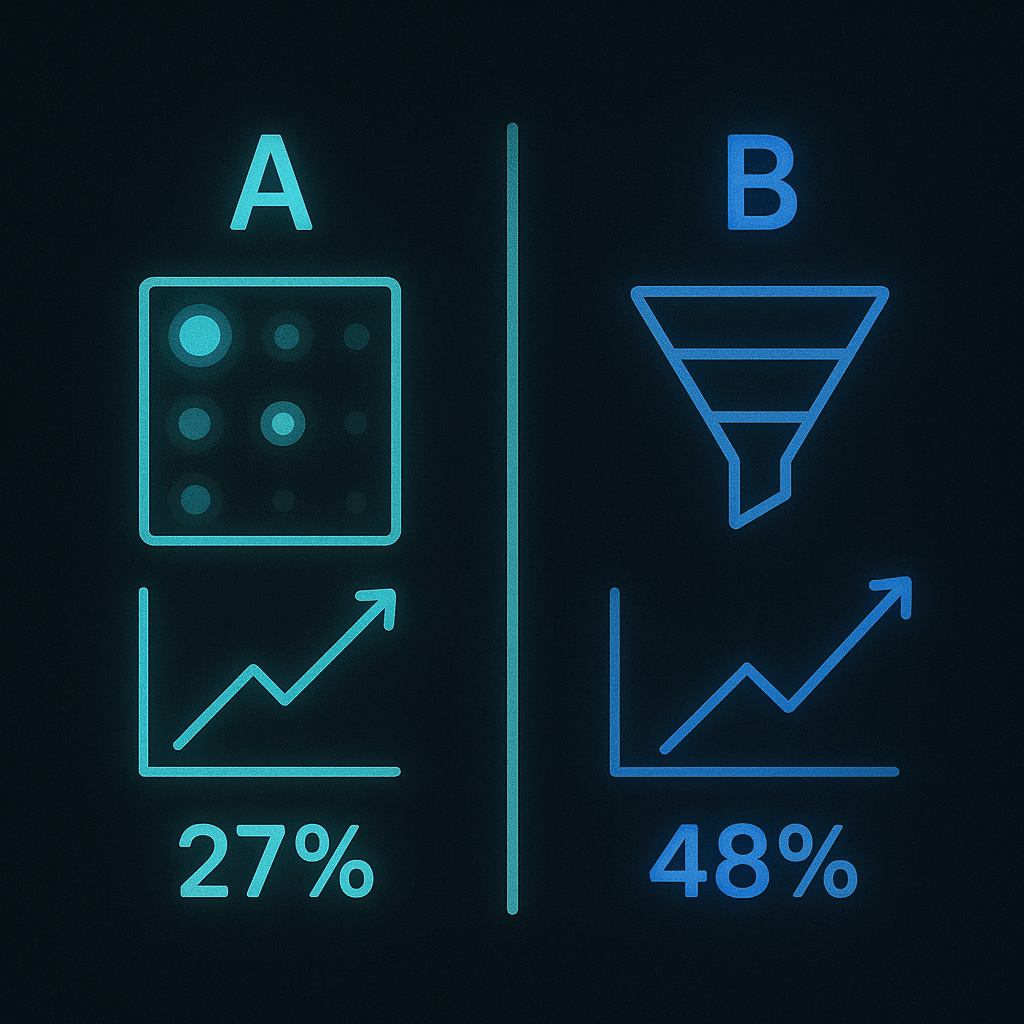
Nothing is fixed with intuition. It’s fixed with data. Implement A/B testing, analyze heat maps, review funnels. Change what slows you down. Scale what pushes.
5. Measure ROI in real time
Don’t wait until the end of the quarter to find out if you lost money. Measure weekly. Adjust on the fly. Avoid disaster with data, not hope.

Un estudio de Deloitte (2025) revela que las empresas con estrategias digitales integradas obtienen un 23% más de rentabilidad que las que operan con canales aislados. — Fuente: Deloitte Digital, 2025
Metrics that matter (in addition to ROI)
ROI is the main filter. But it’s not the only data that matters if you really want to understand what’s working and what’s holding back growth. At CRONUTS.DIGITAL we don’t use decorative metrics. We use numbers that help you make impactful decisions.
These are the metrics that do say something when you look at them with a magnifying glass and demand a return:
CAC: How much does each customer cost you?
Formula: CAC = Total cost of marketing and sales ÷ number of new customers.
If you don’t know how much you are investing to close a customer, you are navigating without a compass. A high CAC (customer acquisition cost) is a red flag: you’re spending more than you get back. Either the acquisition system is poorly tuned, or you are selling poorly. In both cases, it’s time to intervene.
M%-CAC: is marketing performing or burning cash?
Formula: M%-CAC = Cost of marketing team ÷ total CAC
This ratio tells you how much of the CAC is going to marketing alone. If the percentage goes up, beware: the equipment may be overloaded, misaligned or poorly focused. It can also be an initial stage with strong investment. But if it stays high without results…. We have a problem.
LTV/CAC: Are you attracting worthwhile customers?
Formula: LTV ÷ CAC
If the lifetime value of the customer (LTV) does not comfortably exceed what it cost you to acquire them (CAC), you are betting on the wrong horse. This ratio is brutally honest: if you are not generating more than you invest, the system is not sustainable.
Ideally, you want an LTV/CAC of at least 3:1. Less than that and you’re surviving, not growing.
CAC recovery time: When do you really start earning?
Formula: CAC ÷ Monthly margin per customer
Capturing costs. But if you take too long to recoup that investment, your cash flow suffers. This metric tells you how many months it takes for a customer to become profitable.
The shorter the cycle, the more agile your business. If the recovery time is extended, you are not scaling: you are financing your mistakes.
% of customers originating from Marketing: is marketing generating business?
Formula: New customers from Marketing ÷ Total new customers x 100
It’s not enough to say that “marketing helps”. This metric proves it. If marketing is not generating direct customers, it is not a growth driver: it is an expense.
Marketing should be responsible for a clear share of revenue. Not just visibility or engagement.
Frequently Asked Questions
What CMOs and directors ask us.
8 concrete questions answered in ≤ 80 words · optimal format for AI Overviews.
What does an ROI of 30% mean?
How much is a good marketing ROI?
It depends on the context, but as a minimum standard:
-
5:1 (500%) is desirable.
-
10:1 (1000%) is excellent and scalable.
-
Less than 2:1 and you're burning cash.
Don't compare yourself to generic benchmarks. Evaluate if the ROI covers your fixed costs, variable costs and leaves cash to reinvest.
How does the customer journey impact the actual measurement of ROI?
How to integrate data from different teams (sales, product, marketing) to calculate real ROI?
How do you prioritize marketing channels when budgets are limited?
What advanced tools allow you to measure ROI beyond Google Analytics?
-
HubSpot / Salesforce: integrating sales and marketing.
-
Wicked Reports : actual revenue attribution.
-
Triple Whale (ecom): ROI per channel in real time.
-
True Roas / SegMetrics: predictive ROI analysis.
Google Analytics is only a partial view. If you don't connect actual revenue and full costs, you're guessing.