
TL;DR · executive summary
What you’ll find in this article
Picture an SME with five departments and ten AI tools spread among them. Try a simple exercise: ask each department in your company to list the AI tools it uses. Among others, marketing will have a text generator, sales an assistant that summarises meetings, finance an email extension and support a chatbot nobody introduced to management. Each purchase makes sense on its own. Together they do not form a system. What ...
Picture an SME with five departments and ten AI tools spread among them. Try a simple exercise: ask each department in your company to list the AI tools it uses. Among others, marketing will have a text generator, sales an assistant that summarises meetings, finance an email extension and support a chatbot nobody introduced to management. Each purchase makes sense on its own. Together they do not form a system. What is missing has an unglamorous name, AI governance, and in an SME it comes down to something very concrete: deciding what is used, with which data and who is accountable for it.
I notice this pattern because in an SME it is rarely a technology problem. It is a problem of judgement: nobody decided what can be done with AI and what cannot, so each person decides every day.
What AI governance is and why an SME needs it
AI governance is the set of decisions a company makes about how artificial intelligence is used: which tools are approved, which data they can touch, who authorises new ones and who answers when something goes wrong. It sounds like something reserved for large corporations. In an SME it is the opposite: the fewer people there are, the faster you lose track of what each one is doing with each tool.
It is not a committee, an endless manual or a brake on innovation. It is a handful of written rules, few and clear, that let you say yes to a tool knowing what you are approving. A company with rules does not use less AI. It uses it knowing what it does.
Nor is it about banning. When the company’s only answer is no, the use does not disappear: it moves to where nobody can see it. That is why AI governance starts by offering an approved alternative, not by closing doors.
What shadow AI is and why it appears
Shadow AI is the use of AI tools without the company having approved them, or even knowing they exist. It is not born of bad faith. It is born of hurry: someone has a heavy task, finds a free tool that solves it in minutes and uses it. If the company does not offer a clear alternative, the alternative is the free tool.
The risk is not in the tool, but in what is given to it. A customer list pasted into a chat, a contract uploaded to summarise it or a price sheet that leaves the company are decisions nobody made consciously.
There is a detail that gets forgotten: whoever uses a tool without permission almost never does it to hide anything. They do it to meet a deadline. That is why a rule that only prohibits tends to fail, and one that explains what can be done, with which tool and with which data, tends to be followed.
Want to know what each department already uses?
We can review your company’s use of AI together and decide where to start. You can book a video call.
Three signs your company is already there
- Nobody can say exactly how many AI tools are paid for, or by whom.
- Two departments solve the same problem with different tools and results that cannot be compared.
- There is no written rule on which customer, personal or company data can enter an external tool.
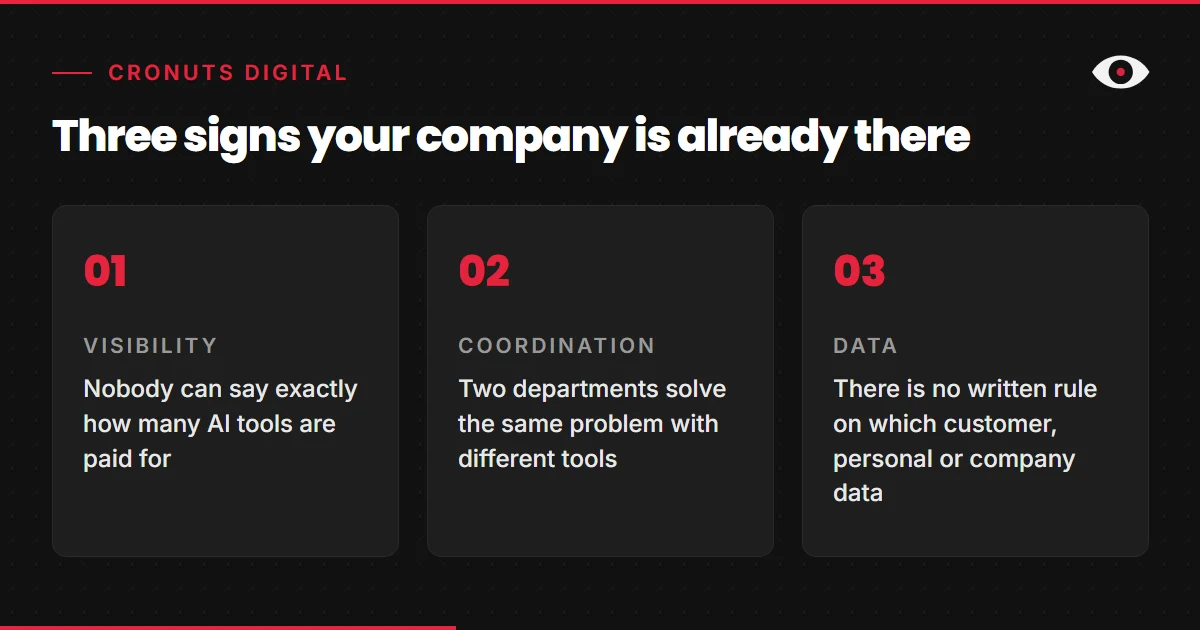
If you recognise one, you probably recognise all three. It is common when adoption runs ahead of decision.
Each sign points to a different gap. The first is about visibility: if you do not know what is paid for, you do not know what is used. The second is about coordination: two teams solving the same thing separately duplicate effort and produce results nobody can then compare. The third is about data and is the most delicate, because without a written rule each person applies their own.
None of the three is fixed by buying another tool. They are fixed with decisions, and decisions start by putting them in writing.
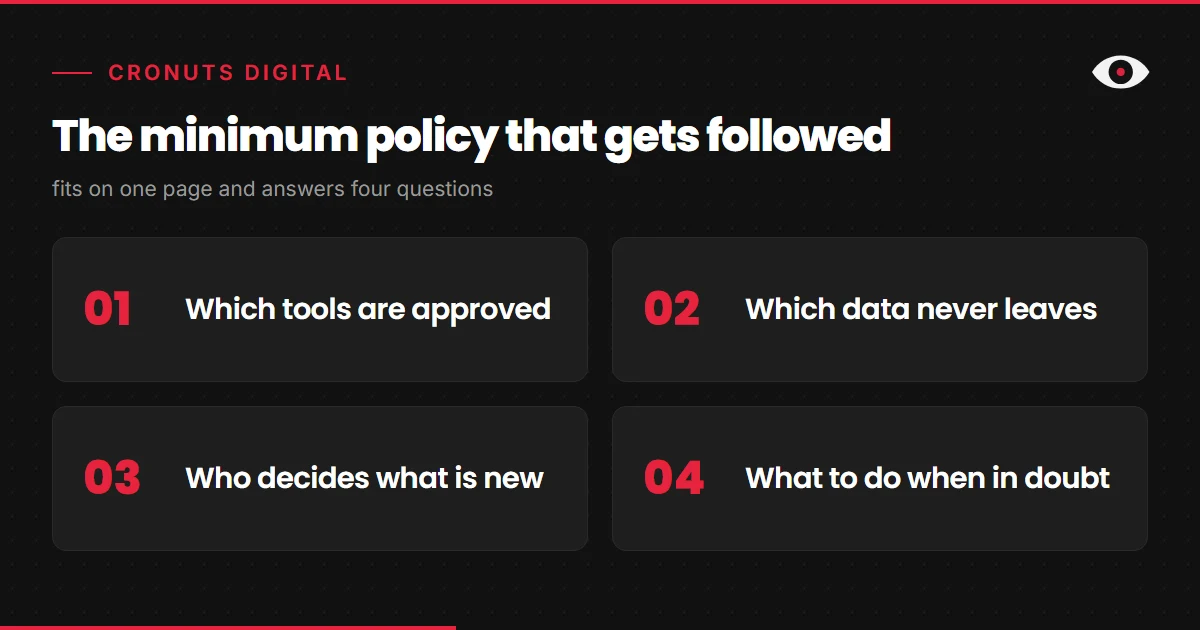
The minimum policy that gets followed
Nobody reads endless AI policies. The one that works fits on a single page and answers four questions: which tools are approved, which data never leaves the company, who decides when a new tool appears and what a person does when in doubt. What matters is that someone can apply it without asking anyone’s permission for every task.
Each of those questions closes a different door:
- Which tools are approved. A short, visible list. If a tool is not on it, you ask before using it and somebody answers.
- Which data never leaves. The customer, personal and company data that cannot be pasted into an external tool. The more concrete the examples, the better the rule is understood.
- Who decides what is new. A person with a first and last name, not an abstract job title.
- What to do when in doubt. A simple path: ask whoever decides before acting, not after.
And it needs an owner. A policy without someone responsible becomes one more document on the shared drive.
With an owner, the policy is updated when a new tool appears or a use changes. Without one, it stays as it was written on day one, and that is the fastest way for it to stop being useful.
The AI map: see before you buy
Before buying another tool, I would take an inventory of what already exists and what each department is trying to solve. It is what I would call an AI map: a single view of processes, tools, the data they touch and the people who use them. It helps you spot duplicates, detect risks and decide where AI really adds value and where it only adds noise.
A useful map answers four things for each tool:
- Which company process it solves.
- Who uses it and who pays for it.
- What data it receives.
- Whether another tool already does the same.
With that sheet in front of you, two things happen. Duplicates become visible, and with them the tools that are surplus. And you see what data each one touches, which is the information you need to write the policy with real examples instead of abstract rules. That is why the map and the policy go hand in hand: the map says what there is and the policy says what is allowed.
It is also where we start at cronuts.digital, a B2B growth marketing and AI consultancy: before proposing anything, we audit the current stack and identify the use cases with the best ROI. Its most useful result may be a list of tools that are surplus, not of the ones that are missing. You can see what we do in our AI service for companies and, if you prefer to go step by step, in how we move forward in closed blocks.
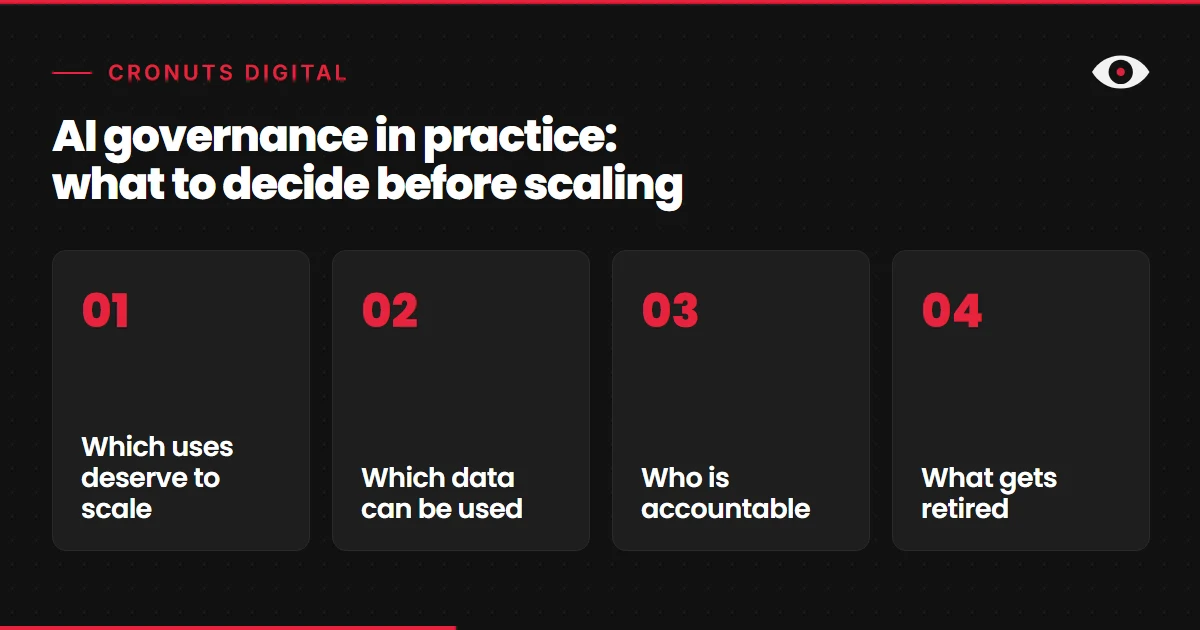
AI governance in practice: what to decide before scaling
Scaling AI means moving from one person or one team using it to it becoming part of how the whole company works. It is the moment a small problem multiplies: if every department already buys on its own, scaling without deciding only gets you more tools with no common criteria.
Before taking that step, AI governance comes down to four decisions:
- Which uses deserve to scale. Not everything that works in a pilot should be extended. You scale what solves a real task better than before.
- Which data can be used. It is set before opening the tool to more people, not after.
- Who is accountable. Each approved tool has a person behind it who knows what it does and who uses it.
- What gets retired. Scaling also means removing: overlapping tools, pilots that went nowhere and accounts nobody uses.
It is an order of work, not a long project. First you see what there is, then you write the rules and only then do you widen the use. Doing it the other way round, with the tools ahead of the rules, is exactly what the opening example describes.
What I would do this week
I would ask each department head for a list of the AI tools their team uses, with no judgement and no consequences. Then I would mark three things on each one: what data it receives, who pays for it and what task it solves. With that on a single sheet, it is already clear what to sort out first.
With that sheet, I would have a second short conversation: which data should not leave any tool and who is going to answer for the policy. You do not need to solve everything in a week. Having a list, a rule on data and a name is enough.
Want to go over it with me?
If you bring your list of tools, we sort it out together. You can book a video call.