
TL;DR · executive summary
What you’ll find in this article
If you search for “what is outbound marketing” in B2B, you find definitions that mix everything together: advertising, cold email, calls, events. I prefer a definition that helps you decide something. B2B outbound means starting the conversation yourself with specific companies that fit your customer profile, instead of waiting for them to find you....
If you search for “what is outbound marketing” in B2B, you find definitions that mix everything together: advertising, cold email, calls, events. I prefer a definition that helps you decide something. B2B outbound means starting the conversation yourself with specific companies that fit your customer profile, instead of waiting for them to find you.
The difference from inbound is not about channel, it is about control. In inbound you decide what to publish and the market decides who arrives. In outbound you decide who you approach, so the result depends on the quality of that decision and not only on volume.
What B2B outbound marketing is and what it is not
B2B outbound is a sequence of contacts aimed at decision-makers in companies you have chosen in advance. The usual channels are email and LinkedIn, although the channel matters least. What defines it is that there is a list, a criterion for being on it and a clear goal: a commercial conversation.
It is not sending the same message to every inbox you can get hold of. That is spam with a budget. Nor is it a substitute for positioning: if the market does not understand what you sell, a cold message will not fix it.
When it works and when it does not
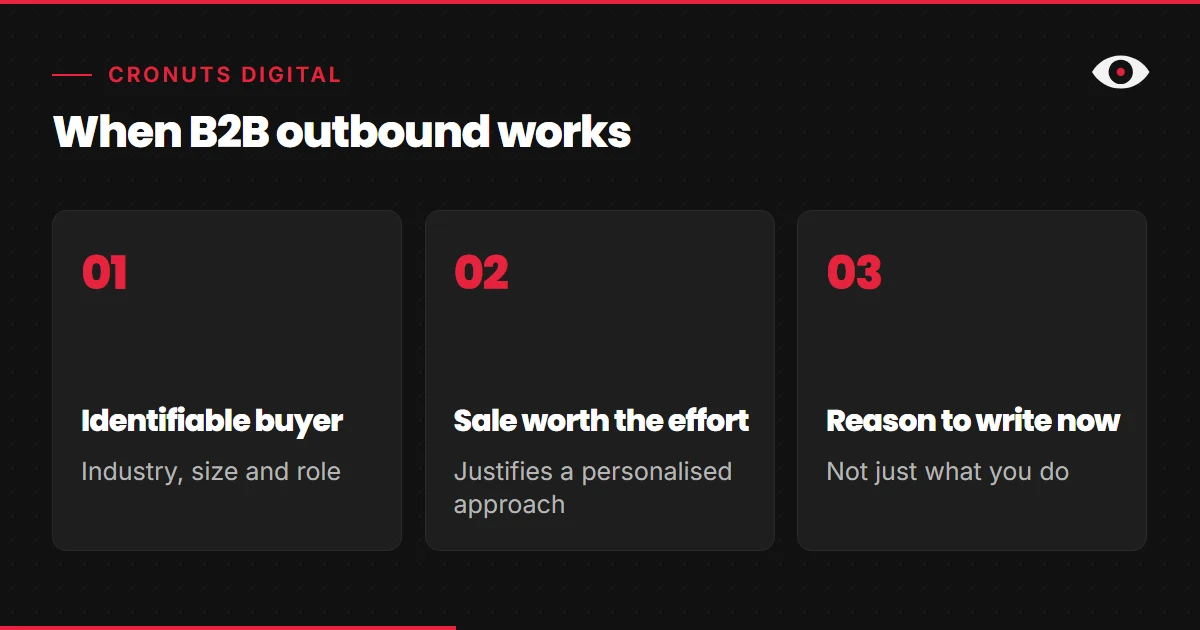
It works best when three conditions are met. The buyer can be identified by industry, size and role. The purchase decision is valuable enough to justify a personalised approach. And there is a concrete reason to write now, not just a description of what you do.
It works badly when the product is bought on impulse, when the customer profile is blurry or when the company cannot handle replies quickly. A positive reply that waits days for an answer is an opportunity given away.
There is a prior point worth being clear about: many sequences fail before they are sent. I explained it in why B2B outbound breaks before the first email: buyer profile, data and deliverability weigh more than the copy.
The KPIs that matter: replies, meetings and cost per meeting
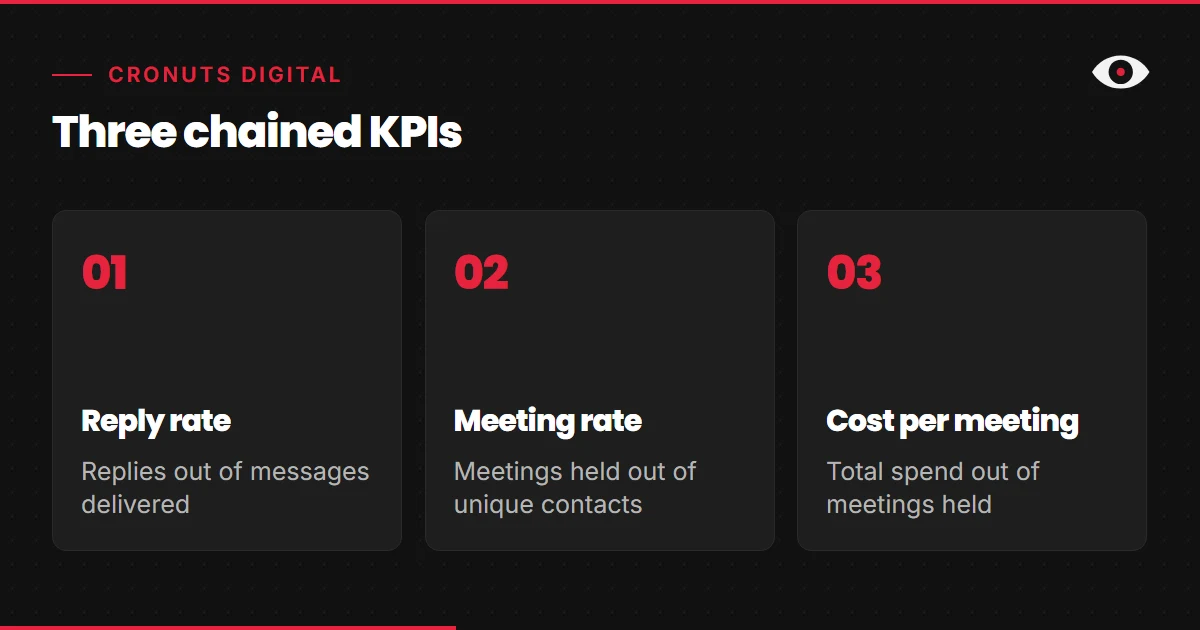
The metric most cited in outbound is the number of emails sent. It is also the one that tells you least, because it measures activity, not results. I would look at three chained indicators.
Reply rate
Replies received divided by messages delivered. It pays to separate positive replies from negative and automatic ones, because an unsubscribe or a “not interested” is also a reply and does not count as progress.
Meeting rate
Meetings held divided by unique contacts approached. What counts is the meeting that happens, not the one that is booked: a call nobody joins is worth nothing. This rate tells you whether the message attracts the right person, not just someone keen to reply.
Cost per meeting
All the system’s spend in a period, divided by the meetings held in that same period. It includes tools, data, domains, the time of whoever manages it and of whoever handles the replies. It is the number that lets you compare outbound with any other acquisition channel.
Two precautions. One: do not compare cost per meeting with the cost per lead of another channel without equalising what counts as success, because a meeting with a decision-maker and a downloaded form are not worth the same. Two: measure long enough windows. In B2B sales with a long cycle, a few days of data are almost never enough to draw conclusions.
How to start measuring it without building a big system
You can start with a spreadsheet. One row per contact, with send date, delivery status, whether there was a reply, of what type and whether it ended in a meeting. With that you can already calculate the three rates. What matters is to record from the first send and not reconstruct it months later from memory.
When volume grows, you will have to decide whether to run it in-house or with a consultancy. At cronuts.digital, a growth marketing and AI consultancy for B2B companies, we have a B2B outbound engine for those who prefer not to build it themselves. The measurement logic above works just as well in both cases.
If you want to review how you measure it today
If you already do outbound and are not sure which rate to look at first, start with the free audit.