
TL;DR · executive summary
What you’ll find in this article
When a B2B client asks me whether Meta Ads for B2B is a good fit, the honest answer is almost never a plain yes or no. It depends on three things you can check before spending a single euro: whether your ideal customer can be targeted on the platform, which quality signal you send back to Meta, and how you tell a lead from an opportunity....
When a B2B client asks me whether Meta Ads for B2B is a good fit, the honest answer is almost never a plain yes or no. It depends on three things you can check before spending a single euro: whether your ideal customer can be targeted on the platform, which quality signal you send back to Meta, and how you tell a lead from an opportunity.
This guide does not explain how to build the campaigns. For that you have our B2B Instagram Ads service and the page on Facebook ads for B2B, where we explain which conditions the channel has to meet. Here I share the criteria I use to decide whether it deserves a test.
What it means for Meta Ads to pay off in B2B
Paying off does not mean a low cost per lead. It means that, once the curious are filtered out, enough commercial opportunities remain to justify what you invested. A submitted form does not tell you whether the person who filled it in was the right buyer. The hard part is getting people to sales who have a real problem, a budget and the power to decide.
That is why my question is not how much a lead costs, but what happens to it a few weeks later. And to answer it, three things have to be solved before launching anything:
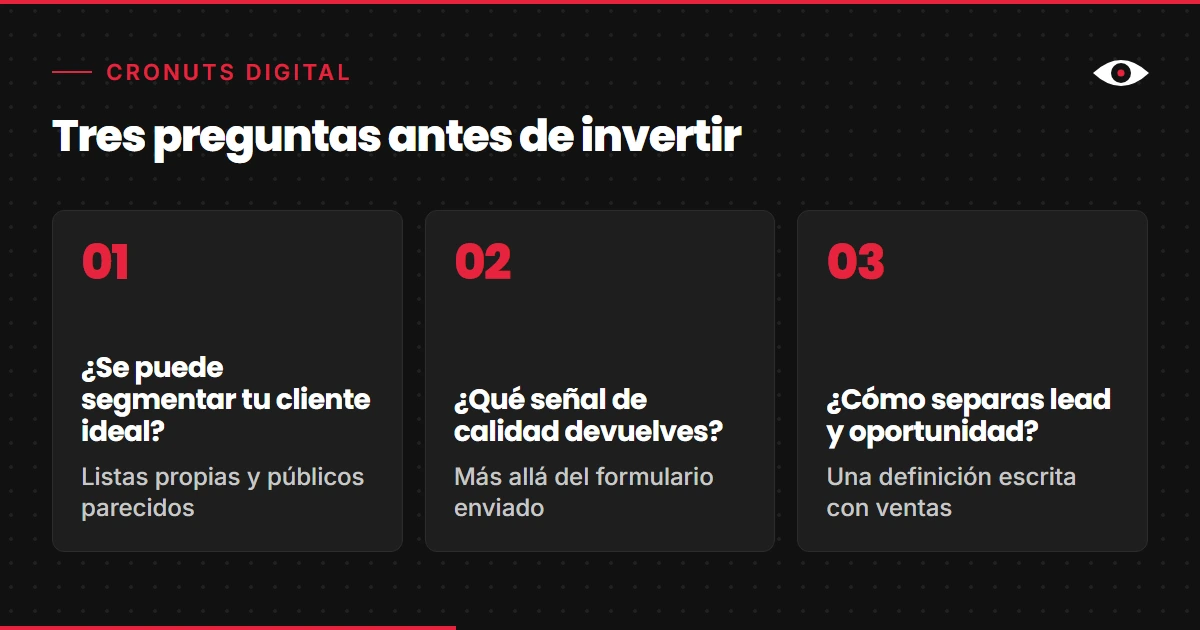
First question: can your ideal customer be targeted?
I would treat job title and company as a clue, not as a reliable filter: before relying on them, check in your own account how many of your real contacts can be found that way. Platforms like Meta also offer other signals, and the exercise is to describe your ideal customer profile (the ICP) with them:
- Your own lists. Current customers, CRM contacts and website visitors.
- Lookalike audiences. People who resemble your best customers, built from those lists.
- Interests and behaviours. Useful when your buyer is a broad profile and not a specific job title.
If all you can do is describe your customer as a very specific job title inside a very specific type of company, and nothing else, I would not start with this channel. If, on top of that, your buyers are few and you know them by name, going straight to them usually works better, as I explain in why B2B outbound breaks before the first email.
If your customer is a small business, a professional or a founder who does spend time on Facebook and Instagram, that is a case where a test makes more sense.
Second question: which quality signal do you send back to the platform?
A campaign optimises towards the event you set as the result. If that event is “form submitted”, the system will look for more people who fill in forms. And that is not the same as finding people who buy.
In B2B it pays to send back something more: that the lead was qualified, that it turned into a meeting or that it moved on to an opportunity. This is usually done with the Conversions API or by uploading conversions from the CRM, as we explain on the page about Facebook ads for B2B. Two things are needed for it to work: the CRM has to record that stage, and it has to be possible to link it to the original click.
If today you do not have a CRM with reliable stages, that is the first thing I would fix, before investing in ads. And if the volume of opportunities is small, the signal will be scarce: you will have to rely on an earlier stage, such as the qualified lead, and make sure it does not get contaminated.
Third question: how do you separate a lead from an opportunity?
Marketing and sales often use the same word for different things. Before launching, I would write three definitions together with sales: what a lead is, what a qualified lead is and what an opportunity is. Each with its criteria, with who decides it and with a CRM field that records it together with the source campaign.
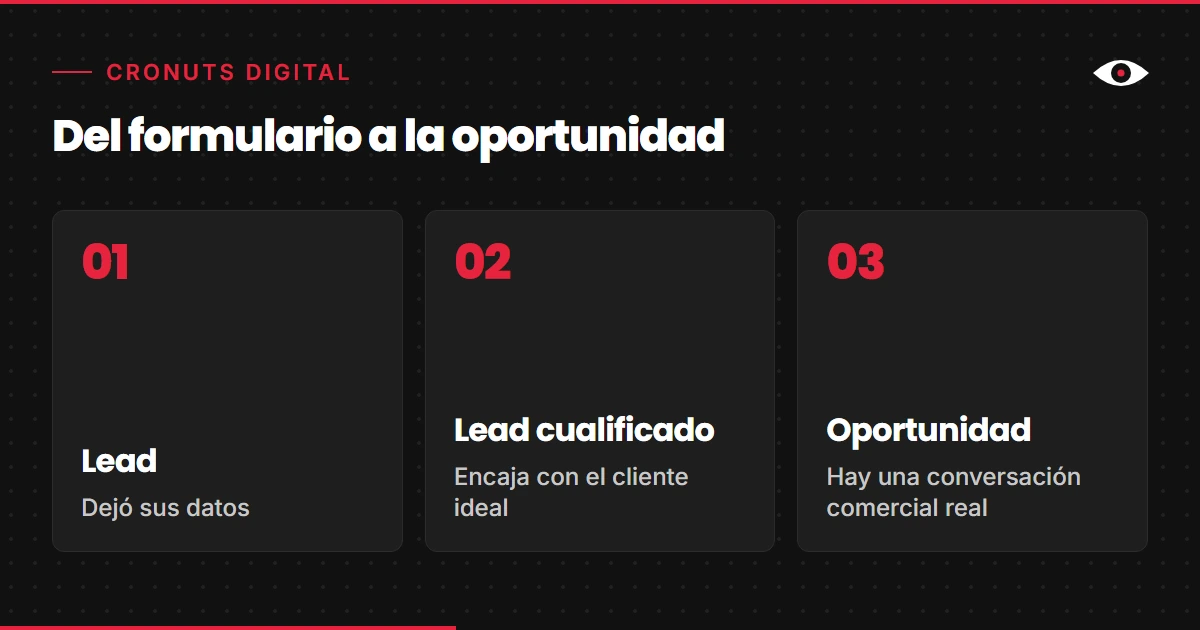
After that comes the review: every week I would manually look at a sample of the campaign’s leads together with the salesperson who handles them. In the Meta panel you see how many forms arrive, and whether they were good is something only sales knows. I explain the full path, from click to invoice, in a submitted form is not a sale.
Want to know if Meta Ads fits your case?
We review your ideal customer, your CRM and what you know today about each lead. Free audit
How to decide: it fits, you test it or you wait
With the three questions answered, my decision usually falls into one of three cases:
- It fits. The ideal customer can be described with signals the platform has, the CRM records the stages, and sales and marketing share the definition of an opportunity.
- You test it. The customer can be targeted, but the quality signal is not set up yet. I build the signal first and run a test with a limited budget and a review date agreed in advance.
- You wait. The buyers are few and known, or there is no reliable CRM, or sales and marketing cannot agree. In that case I would invest first in measurement or in direct prospecting.
If the result is “test it” or “it fits”, on the page about B2B Meta Ads we explain how we work the channel as a consultancy. A B2B lead generation case with Instagram is in B2B lead generation with Instagram for AWS.
Mistakes I see when evaluating Meta Ads
- Launching without agreeing who decides whether a lead is good. Without a salesperson to validate it, each team ends up using the criterion that suits it best.
- Deciding without quality data. Switching off or scaling after a few weeks by looking only at forms.
- Mixing Facebook and Instagram without checking which placement brings what. If you do not separate them, you will not know what to keep.
- Not storing the source campaign in the CRM. Without that data, nobody knows which ad brought the customer who signed.
What I would do this week
I would take the latest customers who have closed with you and look at where they came from and what we knew about them when they came in. That shows whether your ideal customer leaves a trace on the platform, whether the CRM keeps the source, and whether sales and marketing talk about the same thing.
If after that exercise all three answers are yes, you have a reasonable basis for a test. If any of them is no, you already know what to fix before paying for a single ad.
Prefer to review it with your own data?
With your latest closed customers it is quick to see whether the channel makes sense for you. Free audit